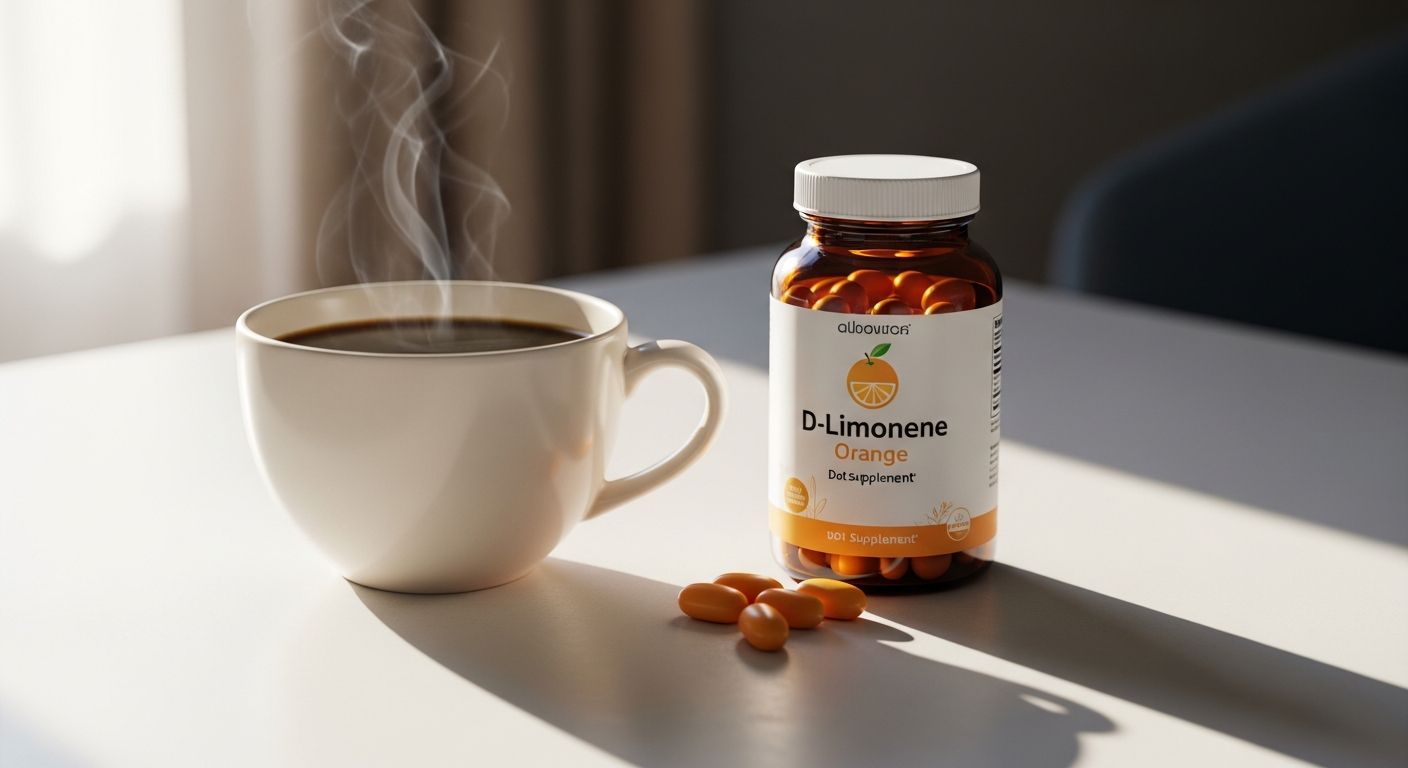
The Coffee Lover’s Dilemma
You love coffee. You also have acid reflux. Your doctor says to cut out coffee. You try. You hate it. You go back to coffee. You hate the reflux. This cycle repeats indefinitely.
You are not alone. An estimated 20 percent of Americans deal with GERD or frequent acid reflux, and coffee is one of the most reported triggers. The standard medical advice — stop drinking coffee — is correct but useless for millions of people.
There is a two-part strategy that addresses the problem from both sides: reducing the trigger and providing protection.
Combining low-acid coffee with d-limonene supplementation targets acid reflux at two different points in the process, and it is grounded in published research.
What Is D-Limonene?
D-limonene is a naturally occurring compound found in the peels of citrus fruits, particularly oranges. If you have ever peeled an orange and noticed the light, fragrant oil on your fingertips, you have encountered d-limonene. It makes up roughly 90 percent of the oil in orange peel.
Despite coming from citrus — which most people associate with acidity — d-limonene itself is not acidic. It is a monoterpene, a hydrocarbon compound studied for several potential health benefits, particularly its effects on the upper digestive tract.
How D-Limonene Works for Acid Reflux
D-limonene appears to help with acid reflux through several mechanisms:
Coating the esophageal and gastric lining. D-limonene is lipophilic (fat-soluble) and floats on top of stomach contents. When you take it as a supplement, it creates a thin protective layer that can coat the esophageal lining and the surface of stomach contents. This coating acts as a barrier between the sensitive esophageal tissue and stomach acid that may reflux upward.
Promoting healthy peristalsis. Some research suggests d-limonene supports normal peristaltic motion — the wave-like muscle contractions that move food and stomach contents downward through the digestive tract. Healthy peristalsis means stomach contents are more likely to move in the right direction (down) rather than refluxing upward.
Neutralizing gastric acid on contact. As a non-acidic substance that floats on stomach contents, d-limonene may help buffer the surface layer of stomach acid, reducing the severity of reflux episodes when they do occur.
Supporting mucosal health. There is preliminary evidence that d-limonene may support the health of the mucosal lining that protects the stomach and esophagus from acid damage.
What the Research Says
A widely cited 2007 study published in the Alternative Medicine Review found that 89 percent of participants reported complete resolution of their GERD symptoms after taking 1,000 mg of d-limonene every other day for 20 days. While this was a relatively small study, the results were striking enough to generate significant interest.
Subsequent research and clinical observation have generally supported d-limonene’s role as a helpful supplement for acid reflux management, though larger controlled studies are still needed. It is not a guaranteed cure, and individual results vary. But for many people, it provides meaningful relief.
Important: D-limonene is a supplement, not a medication. If you have GERD or frequent acid reflux, consult your doctor before starting any new supplement. D-limonene should not replace prescribed treatments without medical guidance.
The Problem: Why Coffee Triggers Acid Reflux
To understand why the d-limonene and low-acid coffee combination works, you need to understand exactly what happens when you drink coffee.
The primary mechanism is Chlorogenic Acid (CQA). This naturally occurring compound in coffee beans triggers parietal cells in the stomach lining to produce excess hydrochloric acid. UC Davis research identified CQA as the main compound responsible for coffee-related heartburn and acid reflux. For the full explanation, see our CQA explainer.
The sequence looks like this:
- You drink coffee containing CQA.
- CQA stimulates your stomach to produce more acid than normal.
- The excess acid increases pressure on your lower esophageal sphincter (LES).
- Acid pushes past the LES and enters your esophagus.
- You experience heartburn, regurgitation, or other reflux symptoms.
Caffeine plays a secondary role by mildly relaxing the LES, making it easier for acid to escape upward. But CQA-driven acid overproduction is the dominant factor. This is why decaf coffee still causes reflux for many people — the caffeine is reduced, but the CQA remains.
The Two-Part Strategy
If you think of acid reflux as a problem with two components — too much acid being produced and insufficient protection against the acid that does reflux — then it makes sense to address both components at once.
Part 1: Reduce the Trigger With Low-CQA Coffee
The first and most logical step is to reduce the amount of CQA your stomach has to deal with. Less CQA means less excess acid production, which means less acid available to cause reflux.
You do not have to give up coffee. You choose coffee that has been processed to reduce CQA content.
Convection roasting — the method we use at Low Acid Cafe — uses circulating hot air to roast beans instead of a traditional hot metal drum. The even heat distribution breaks down CQA more thoroughly and consistently, resulting in lower CQA levels while maintaining a full-flavored medium roast. No additives, no chemical treatment, no compromise on taste. The CQA reduction is lab-verified. Read more about how convection roasting works.
This differs from pH-adjusted coffees that add calcium carbonate or other alkaline substances. Those products change the pH number on the label but do not reduce the CQA that triggers your stomach to overproduce acid. You can learn more about why this distinction matters in our guide on what low-acid coffee is.
What this accomplishes: By reducing CQA intake, you reduce the signal that tells your stomach to overproduce acid. Less acid production means less pressure on the LES and less acid available to reflux. You have addressed the trigger side of the equation.
Part 2: Add Protection With D-Limonene
Even with reduced CQA coffee, your stomach still produces some acid (which is normal and necessary for digestion). And if you have a history of acid reflux, your LES may be prone to allowing some backflow regardless of what you eat or drink.
This is where d-limonene comes in as the second line of defense.
By taking d-limonene as a supplement, you add a protective layer that:
- Coats the esophageal lining, reducing the damage from any acid that does reflux.
- Floats on top of stomach contents, creating a barrier between the acid and the LES.
- Supports healthy digestive motility, keeping things moving in the right direction.
What this accomplishes: Even if some acid reflux occurs, the d-limonene provides a protective buffer that reduces the severity and discomfort. You have addressed the protection side of the equation.
Why the Combination Is More Effective Than Either Alone
Low-acid coffee alone reduces the trigger but does not protect against breakthrough reflux from other causes (stress, other foods, body position, etc.).
D-limonene alone provides protection but does not reduce the excess acid production triggered by CQA. You are fighting the fire while still pouring fuel on it.
Together, they work on both sides of the problem:
| Approach | Reduces acid trigger? | Provides protection? |
|---|---|---|
| Regular coffee + nothing | No | No |
| Regular coffee + d-limonene | No | Yes |
| Low-CQA coffee + nothing | Yes | No |
| Low-CQA coffee + d-limonene | Yes | Yes |
The combination does not guarantee zero reflux — nothing does. But it improves the odds compared to either approach alone.
How to Implement This Strategy
Choosing Your Low-CQA Coffee
The non-negotiable requirement is that the coffee must have reduced CQA levels — not just a lower pH from additives. Look for:
- Convection-roasted coffee (targets CQA reduction).
- Lab-verified acid levels (not just marketing claims).
- No additives like calcium carbonate (addresses the wrong problem).
- Quality beans from naturally low-acid growing regions.
Low Acid Cafe checks all of these boxes. It is a blend of Sumatran and Chiapas beans, organic, fair trade, convection-roasted, and lab-verified for low CQA. It is designed for exactly this purpose. Visit our science page for the full details on our roasting process and lab results.
Choosing a D-Limonene Supplement
D-limonene supplements are widely available. When selecting one, look for:
- Pure d-limonene derived from orange peel oil.
- 1,000 mg dosage (the amount used in most studies).
- Softgel form (d-limonene is an oil, and softgels deliver it most effectively).
- Reputable manufacturer with quality testing.
Orange Burps is a d-limonene supplement formulated for acid reflux support — a 1,000 mg softgel of pure d-limonene from orange peel oil, with over 5,000 reviews across Amazon, Walmart, and direct sales. It is made by the same parent company as Low Acid Cafe. We designed these two products as a pair to address both sides of the coffee and reflux equation.
The Daily Protocol
A practical way to combine both approaches:
Morning routine:
- Take one d-limonene softgel on an empty stomach with a small glass of water. Some people find taking it 15 to 20 minutes before coffee works best, allowing the d-limonene to begin coating the upper digestive tract.
- Have breakfast or at least a small snack.
- Brew your low-CQA coffee using a paper filter method (drip or pour-over).
- Enjoy your coffee with or immediately after food.
If you drink a second cup:
- Keep it earlier in the day (before early afternoon).
- The d-limonene from your morning dose typically provides coverage for several hours.
- Some people take a second d-limonene softgel before their afternoon coffee if needed.
Timing notes:
- D-limonene does not need to be taken daily forever. Many users find that after two to three weeks of daily use, they can switch to every other day or as-needed use.
- The low-CQA coffee habit, on the other hand, should be consistent. Every cup of regular coffee is another dose of CQA your stomach has to handle.
Who Benefits Most From This Approach?
This two-part strategy is well-suited for:
- Coffee lovers who have been told to quit coffee due to acid reflux or GERD but do not want to give it up entirely.
- People currently managing reflux with antacids (like Tums) who want a more proactive approach rather than just treating symptoms after they occur.
- Anyone who has tried “low-acid” coffee (the pH-adjusted kind) and found it did not help — because it was addressing the wrong problem.
- People who want to reduce their reliance on PPIs (like omeprazole) and are looking for complementary strategies. See our related article on coffee and omeprazole for more on this topic.
- Bariatric surgery patients reintroducing coffee who need maximum gentleness. See our guide on coffee after bariatric surgery.
What This Strategy Is Not
Some boundaries worth stating:
- This is not a cure for GERD. GERD is a medical condition that may require medical treatment. This strategy can complement medical management, not replace it.
- This is not a substitute for your doctor’s advice. If you are on prescribed medication for acid reflux, do not stop it based on this article. Talk to your doctor about complementary approaches.
- This will not work for everyone. Individual digestive physiology varies. Some people have reflux triggers beyond CQA and caffeine. Some people have structural LES issues that require medical intervention regardless of what they eat or drink.
- D-limonene is a supplement, not a drug. It is not FDA-approved for the treatment of any condition. It is generally recognized as safe (GRAS status), but discuss it with your healthcare provider, especially if you are pregnant, nursing, or taking other medications.
Frequently Asked Questions
Can I use d-limonene with regular coffee instead of switching to low-acid?
You can, and some people do find relief. But you are only addressing the protection side while leaving the trigger fully active. For many people, d-limonene alone is not enough to offset the full CQA load of regular coffee. The combination approach gives you the best odds.
Does d-limonene interact with any medications?
D-limonene is generally well-tolerated, but it can theoretically interact with medications metabolized by certain liver enzymes (CYP2C9 and CYP2C19). If you are taking prescription medications, especially blood thinners or anti-seizure medications, consult your doctor before starting d-limonene. Visit our FAQ for more common questions.
How long until I notice a difference?
Most people notice the coffee switch immediately — the first cup of low-CQA coffee is noticeably gentler than regular coffee. D-limonene effects typically build over several days to two weeks of consistent use, though some people notice improvement from the first dose.
Is this approach safe long-term?
Low-CQA coffee is just coffee roasted differently — there are no safety concerns with long-term use. D-limonene has GRAS status and has been used as a food additive and supplement for decades without significant safety concerns. That said, discuss any long-term supplement use with your healthcare provider.
What if I still get reflux with this combination?
If the combination of low-CQA coffee and d-limonene does not adequately control your reflux, that is important information — it suggests other factors are at play. Talk to your doctor. You may have triggers beyond coffee, structural issues with your LES, or other conditions contributing to your symptoms. The goal is to find what works for your body, and sometimes that requires medical investigation.
The Bottom Line
Acid reflux does not have to mean giving up coffee.
Reducing the CQA trigger with convection-roasted low-acid coffee and adding esophageal protection with d-limonene creates a complementary defense that addresses the problem from both directions. Not a magic bullet, but for many people, it is the difference between suffering through coffee, suffering without coffee, and enjoying coffee again.
Low Acid Cafe handles the coffee side. Orange Burps handles the d-limonene side. Together, they offer a practical, evidence-based approach to one of the most common daily frustrations for reflux sufferers. Explore the science behind our coffee or shop now to get started.