How Coffee Roasting Works
Before comparing methods, it helps to understand what roasting actually does to a coffee bean.
A green (unroasted) coffee bean is dense, grassy-smelling, and not particularly pleasant to eat or brew. Roasting transforms it through a complex series of chemical reactions driven by heat:
Maillard reaction: Starting around 300 degrees F, amino acids and sugars react to produce hundreds of aromatic compounds. This is the same reaction that browns bread crust and gives seared meat its flavor. In coffee, it creates caramel, chocolate, and nutty notes.
Caramelization: Sugars break down and recombine at higher temperatures, producing sweetness and complexity.
Strecker degradation: Amino acids break down to form aldehydes — volatile aromatic compounds that contribute to coffee’s distinctive smell.
First crack: Around 385 to 400 degrees F, moisture inside the bean builds enough pressure to crack the cell structure, producing an audible popping sound. First crack marks the transition from light to medium roast.
CQA thermal degradation: Chlorogenic Acid breaks down throughout roasting, accelerating as temperature and duration increase. This is the key reaction for low-acid coffee.
Second crack: Around 435 to 450 degrees F, the bean’s cellulose structure begins to fracture. This marks the transition into dark roast territory. Beyond second crack, the bean is rapidly approaching carbonization.
The roaster’s job is to manage these reactions — applying enough heat to develop flavor while avoiding scorching, underdevelopment, or over-roasting. How you apply that heat has a major effect on the outcome.
Drum Roasting: The Industry Standard
About 95% of all commercial coffee is drum roasted. The method has been the default since the 19th century, and the basic principle has not changed much.
How Drum Roasting Works
A drum roaster consists of a horizontal rotating metal cylinder (the drum) positioned over or around a heat source. Green coffee beans are loaded into the drum, which rotates to tumble the beans as they are heated.
Heat transfer in a drum roaster comes from three sources:
-
Conduction (dominant): Beans contact the hot metal surface of the drum directly. Each time a bean touches the drum wall, it absorbs heat through direct contact. This is the primary heat transfer mechanism in most drum roasters.
-
Convection (minor): Hot air circulates through the drum to some degree, providing supplemental heat. The amount of convective heat varies by roaster design — some have stronger airflow than others — but it is secondary to conduction in most drum roasters.
-
Radiation: The hot drum surfaces radiate infrared energy toward beans not in direct contact. This is the weakest of the three mechanisms in a typical drum roaster.
Strengths of Drum Roasting
Proven and well-understood. Centuries of accumulated knowledge exist around drum roasting. Most roasters learn on drum machines, and most roasting science and reference points are based on drum roasting profiles.
Cost-effective at scale. Drum roasters are cheaper to build and operate than convection roasters. They are available in a wide range of sizes, from small sample roasters to massive industrial units capable of roasting hundreds of kilograms per batch.
Flavor tradition. Much of what we consider “classic” coffee flavor was developed on drum roasters. The slight caramelization from direct contact with hot metal can contribute pleasant toasty notes.
Availability. Drum roasters are everywhere. Nearly every local roaster, every commercial roasting operation, and every coffee brand uses drum roasters as their primary equipment.
Limitations of Drum Roasting
Uneven heat application. This is the fundamental challenge. At any given moment, only a fraction of the beans in the drum are in contact with the hot metal surface. The rest are tumbling through the air between contacts. This means beans receive heat in intermittent bursts rather than continuously.
Within each bean, the side touching the drum gets more heat than the exposed side. The surface heats faster than the interior. The outside of the bean may be at a much higher temperature than the center, especially early in the roast.
Scorching and tipping. When beans contact a very hot drum surface, the point of contact can scorch — creating a blackened, bitter spot on the bean. “Tipping” refers to scorching at the ends of the bean where the cell structure is weakest. Both are common drum roasting defects that skilled roasters try to minimize but cannot entirely eliminate.
Inconsistent CQA reduction. Because heat penetration is uneven, CQA degradation within each bean is also uneven. The outer layers of the bean may have significantly reduced CQA while pockets in the interior retain higher concentrations. The average CQA level of the bean might be moderate, but the distribution is uneven — meaning some sips of your coffee carry more CQA than others.
Chaff management. As the outer skin (chaff) of the bean separates during roasting, it can char on the hot drum surface, contributing smoke and bitterness to the roast.
Convection Roasting: The Air-Roasting Alternative
Convection roasting (also called air roasting or fluid bed roasting) takes a different approach to applying heat.
How Convection Roasting Works
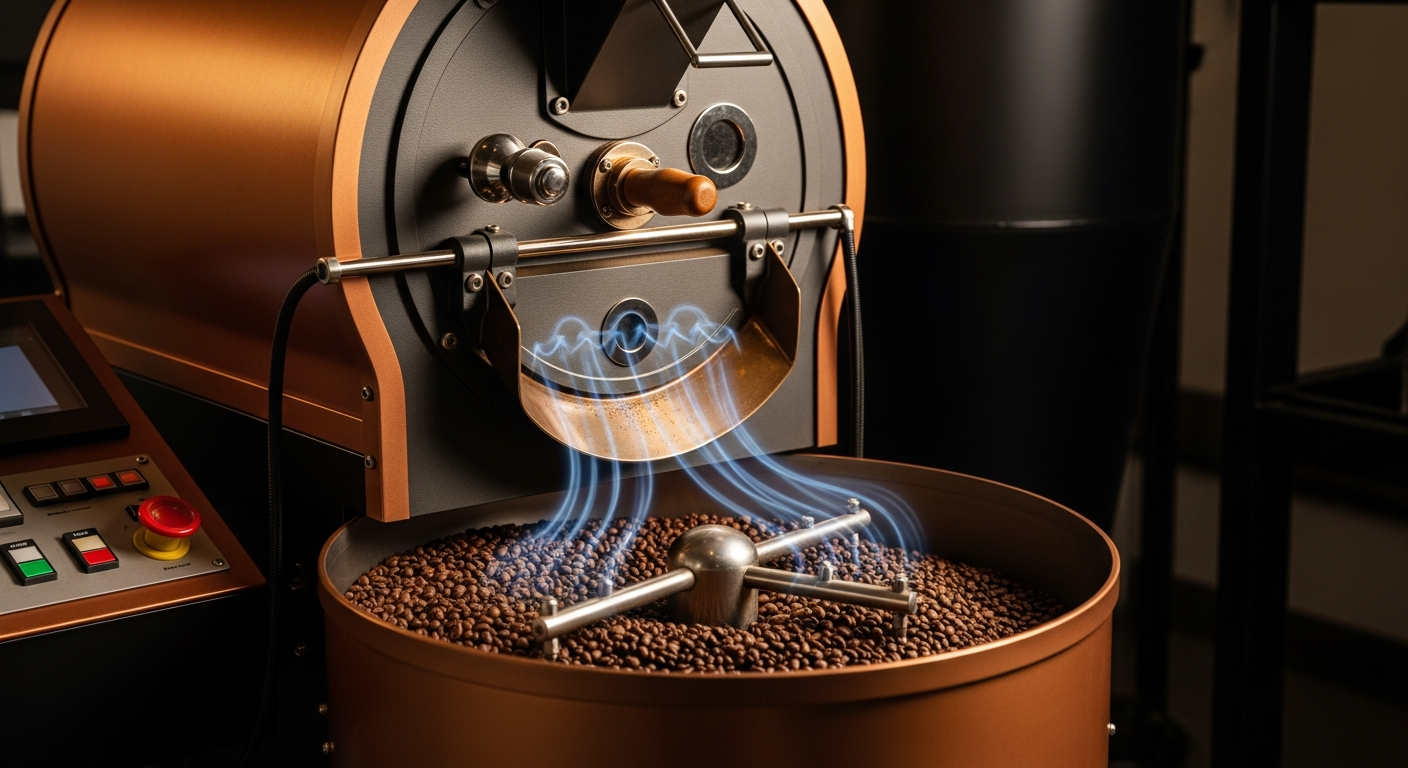
In a convection roaster, a powerful stream of heated air is directed through the roasting chamber. The air suspends and tumbles the beans — similar to a popcorn popper, but with precise temperature control and airflow management.
Heat transfer in a convection roaster comes primarily from one source:
-
Convection (dominant): Heated air surrounds every surface of every bean simultaneously. Heat transfer is continuous and uniform. There is no hot metal surface for beans to contact.
-
Conduction (minimal): Beans occasionally contact each other as they tumble in the airstream, transferring small amounts of heat between them. This is a minor factor.
-
Radiation (minimal): The chamber walls radiate some heat, but this is far less significant than in a drum roaster where the drum itself is the primary heat source.
Advantages of Convection Roasting
Even heat distribution. This is the defining advantage and the reason convection roasting matters for low-acid coffee. Hot air surrounds every bean from all directions at once, so heat penetrates uniformly. The surface and the core of the bean reach similar temperatures at similar rates. No hot spots, no cold spots, no scorching.
Uniform CQA reduction. Because heat penetrates evenly, CQA degrades uniformly throughout the bean. There are no under-roasted pockets retaining high CQA concentrations. At any given roast level, a convection-roasted bean will have more thorough, more consistent CQA reduction than a drum-roasted bean.
Medium roast with low CQA. This is the practical breakthrough. In drum roasting, achieving thorough CQA reduction requires going to a dark roast — the extended time at high temperature eventually penetrates to the core. In convection roasting, thorough CQA reduction happens at a medium roast level because the heat does not need extra time to reach the interior.
The result: a coffee that has CQA levels typically associated with dark roast while maintaining the flavor profile of a medium roast. You get low acid and good flavor — the combination that drum roasting struggles to achieve.
Cleaner roast. Without direct contact with hot metal, there is no scorching, no tipping, and less chaff carbonization. The roast is cleaner, producing a smoother cup with less bitterness.
Faster roast time. Convection roasting is more thermally efficient than drum roasting. Roast times are typically shorter, which reduces the formation of bitter compounds associated with extended roasting.
Better chaff removal. The strong airflow in convection roasters blows chaff away from the beans immediately, preventing it from charring and contributing off-flavors.
Limitations of Convection Roasting
Cost. Convection roasters are more expensive to build and operate than drum roasters. The powerful blowers and precise air heating systems require more sophisticated engineering. This is the primary reason most commercial roasters use drum machines.
Batch size limitations. Convection roasters generally handle smaller batches than industrial drum roasters. This makes them less cost-effective for high-volume commodity coffee production.
Different flavor profile. Some roasters and coffee professionals argue that drum roasting’s conduction heat creates certain desirable flavor characteristics — specifically, a toasty, caramelized quality from the brief bean-to-metal contact. Convection roasting produces a “cleaner” profile that some traditionalists find less complex. This is largely a matter of preference.
Less common expertise. Because drum roasting dominates the industry, most roasting knowledge, training programs, and profile development tools are optimized for drum roasters. Convection roasting requires a different skill set and different profile development approach.
Noise. The powerful blowers in convection roasters are louder than the gentle tumbling of a drum roaster. This is a practical concern for roasting facilities, not for the end consumer.
The CQA Reduction Comparison
To illustrate the difference in practical terms, consider two hypothetical batches of the same green coffee beans roasted to the same medium roast level — one on a drum roaster, one on a convection roaster.
Drum-roasted medium:
- Surface CQA: Low (well-exposed to heat)
- Core CQA: Moderate to high (under-roasted relative to surface)
- Overall CQA: Moderate (average of uneven distribution)
- Flavor: Good medium roast character, possible minor scorching notes
Convection-roasted medium:
- Surface CQA: Low
- Core CQA: Low (uniform heat penetration)
- Overall CQA: Low (consistent throughout the bean)
- Flavor: Clean medium roast character, no scorching
The convection-roasted bean has lower total CQA because it does not have those high-CQA pockets that the drum-roasted bean retains. This difference is measurable and verifiable through laboratory testing.
At Low Acid Cafe, our patented convection roasting process is optimized for CQA reduction. Third-party lab testing verifies that our coffee achieves lower CQA levels than conventionally roasted coffee at comparable roast levels. You can see our lab results on the Science page.
Why Most Coffee Is Still Drum Roasted
If convection roasting produces a better result for low-acid coffee, why doesn’t everyone use it?
Economics. Most coffee is not marketed as low-acid. For conventional coffee production, drum roasters offer a proven, cost-effective, scalable solution. The uneven CQA reduction is not a problem if you are not trying to minimize CQA.
Scale. The global coffee industry produces roughly 10 billion kilograms of coffee per year. That volume requires massive-scale roasting operations, and drum roasters currently offer the most cost-effective path to that scale.
Tradition and training. The coffee industry is deeply rooted in drum roasting traditions. Roasting courses teach drum roasting. Competitions use drum roasters. Profiles are designed for drum roasters. Switching to convection would require retraining and re-equipping.
The CQA connection is recent. The understanding that CQA — not pH — drives coffee-related acid reflux is based on research still gaining wider awareness. As this knowledge spreads, demand for convection-roasted, low-CQA coffee will grow.
For coffee drinkers who do not experience acid issues, drum roasting works fine. But for the estimated 60 million Americans with acid reflux, and the 20% of the population with GERD, the roasting method becomes medically relevant.
What About Hybrid Roasters?
Some modern roasters combine drum and convection elements — a rotating drum with enhanced airflow systems. These machines offer improved evenness compared to pure drum roasting, and some can approximate convection roasting’s uniformity.
However, “hybrid” covers a wide range of designs. Some are essentially drum roasters with better ventilation. Others are much closer to true convection systems. If a brand claims to use a hybrid approach for acid reduction, the relevant question is: what does the lab testing show?
Choosing Coffee Based on Roasting Method
If acid reflux is a concern, use this framework:
-
Look for convection-roasted or air-roasted coffee specifically marketed for low acid. The roasting method should be a central part of the brand’s story, not an afterthought.
-
Ask for or look for lab verification. The roasting method creates the potential for low CQA, but actual CQA levels depend on the specific roasting profile, bean selection, and process control. Lab testing confirms the result.
-
Medium roast is the sweet spot. If a convection-roasted coffee is available in medium roast, that is ideal — you get both the flavor benefits of medium roast and the CQA reduction benefits of convection roasting. A convection-roasted dark roast would have even less CQA but sacrifices flavor unnecessarily.
-
Consider the complete picture. Roasting method matters, but so does bean selection, sourcing quality, and freshness. A convection-roasted coffee from poor-quality beans will be low-acid but not enjoyable. Look for a coffee where every element — beans, sourcing, roasting — is chosen with care.
At Low Acid Cafe, we combine organic, fair trade Sumatran and Chiapas beans with patented convection roasting to produce a coffee that is low in acid, rich in flavor, and backed by lab verification.
Learn more about our process on the Science page, or visit our FAQ for answers to common questions about our roasting method.