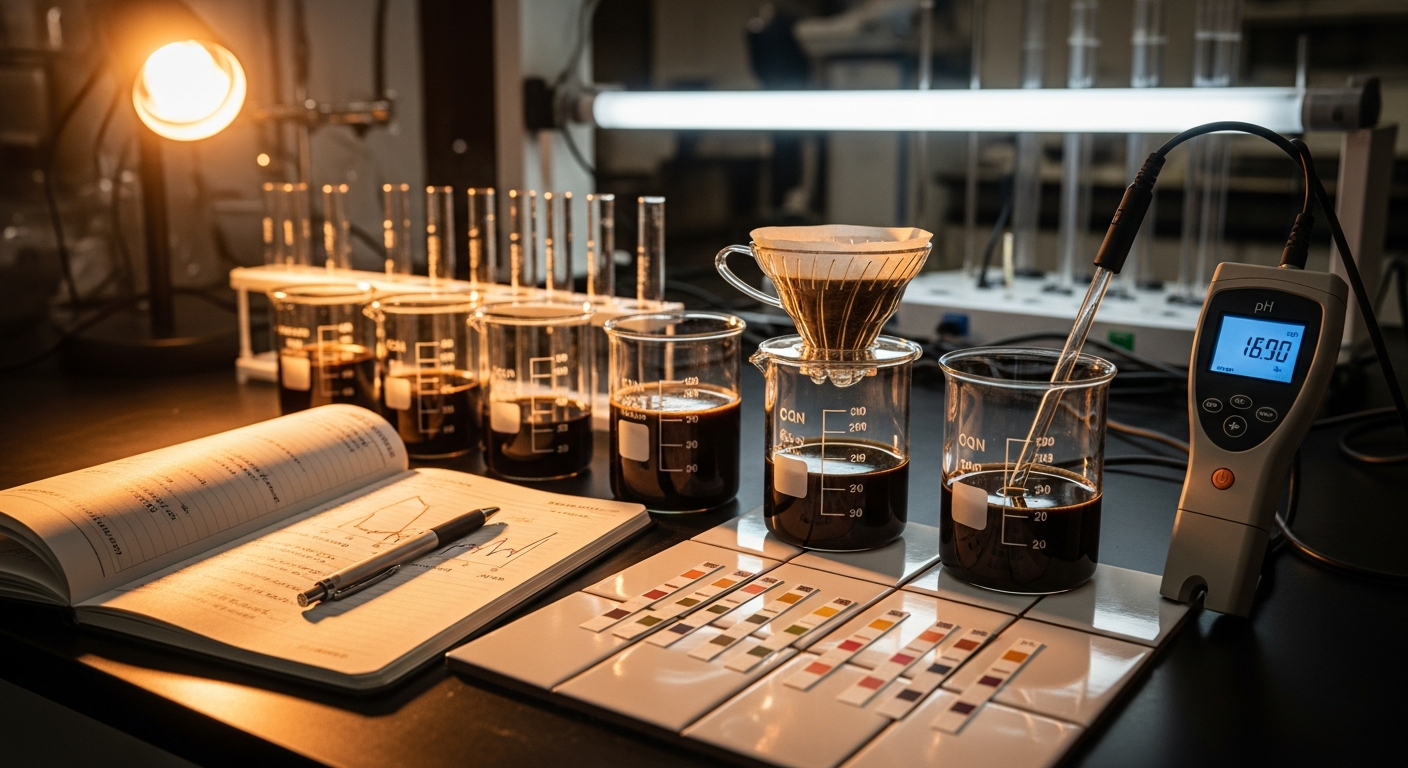
The pH Myth in Coffee
Walk into any health food store and you will find “low acid” coffees advertising their pH levels. pH 5.5. pH 6.0. “Alkaline-friendly.” The messaging implies that if you just raise the pH, you solve the stomach problem.
That story is incomplete.
pH measures the concentration of hydrogen ions in a solution — essentially, how acidic the liquid itself is on a scale from 0 (most acidic) to 14 (most alkaline). Regular coffee typically lands between 4.85 and 5.10 on this scale. That is more acidic than water (pH 7) but far less acidic than orange juice (3.5), tomato juice (4.0), or soda (2.5).
If pH were the whole story, orange juice should cause far more heartburn than coffee. For some people it does — but for many, coffee is a worse trigger despite having a higher pH. That paradox is what led researchers to look beyond pH for the real mechanism.
What Is Chlorogenic Acid (CQA)?
Chlorogenic Acid — abbreviated as CQA from its chemical classification as caffeoylquinic acid — is a family of polyphenolic compounds found abundantly in coffee beans. In green (unroasted) coffee, CQA can account for up to 12% of the dry weight of the bean, making it one of the most concentrated compounds in coffee.
CQA is not unique to coffee. It appears in many plants, including apples, blueberries, potatoes, and artichokes. In moderate amounts, CQA has documented antioxidant and anti-inflammatory properties. It is one of the reasons coffee consumption has been associated with certain health benefits in epidemiological studies.
But in the concentrations found in coffee — especially lightly roasted coffee — CQA has a very specific and well-documented effect on the human digestive system.
How CQA Triggers Stomach Acid Production
The mechanism matters for reflux sufferers:
When CQA reaches the stomach lining, it interacts with parietal cells — the cells responsible for producing hydrochloric acid (HCl). CQA stimulates these cells to ramp up acid production beyond normal levels. The result is a surge of stomach acid that can overwhelm the lower esophageal sphincter (LES) and cause the burning sensation of acid reflux.
This is a different mechanism than the coffee itself being acidic. Consider the distinction:
- pH effect: The coffee liquid is mildly acidic when it reaches your stomach, adding a small amount of acid to whatever is already there.
- CQA effect: A specific compound in the coffee triggers your stomach to produce more of its own acid — hydrochloric acid at a pH of around 1.5 to 2.0, far more potent than the coffee itself.
The CQA effect is the dominant one. Your stomach produces acid that is orders of magnitude more acidic than the coffee you drank. The coffee’s own pH contribution is almost negligible by comparison.
This explains why someone can drink a “pH-balanced” coffee that has been treated with calcium carbonate and still experience heartburn. The CQA is still there, still triggering acid production. The added alkaline buffer might neutralize the coffee’s pH, but it does not stop the CQA from signaling your stomach to make more acid.
The UC Davis Research
Researchers at the University of California, Davis conducted studies examining the relationship between specific coffee compounds and gastric acid secretion. Their work was part of a broader effort to understand why coffee affects the stomach differently than other beverages with similar pH levels.
The key findings:
-
CQA is the primary driver of coffee-induced gastric acid secretion. Among the many compounds in coffee, CQA was identified as the one most responsible for triggering excess stomach acid production.
-
The effect is dose-dependent. More CQA in the coffee means more stomach acid production. This is why lighter roasts (which retain more CQA) tend to cause more stomach issues than darker roasts (which have less CQA remaining).
-
N-methylpyridinium (NMP), a compound formed during roasting, may have a protective effect. NMP appears to counteract some of the acid-stimulating effects of CQA. Darker roasts have more NMP, which partially explains their gentler effect on the stomach — they have less CQA and more NMP.
-
pH alone is not a reliable predictor of a coffee’s stomach impact. Two coffees with identical pH levels can have very different CQA concentrations and therefore very different effects on gastric acid production.
These findings shifted the scientific understanding of coffee and stomach health away from simple pH measurement toward a picture involving specific compound concentrations.
CQA Levels Across Roast Profiles
CQA degrades through thermal decomposition during roasting. The longer and hotter the roast, the more CQA is broken down. Here is the general relationship:
Green (unroasted) beans: Highest CQA — up to 12% of dry weight. Obviously not drinkable as coffee.
Light roast: Significant CQA remains. These beans have been roasted just past first crack. They retain the most origin character and the most CQA. Light roast is the most likely to trigger reflux.
Medium roast: Moderate CQA reduction. The standard roast level for many commercial coffees. Some people tolerate medium roast fine; others still experience symptoms.
Dark roast: Substantial CQA reduction. Extended roasting time breaks down most of the CQA. However, it also destroys many of the volatile flavor compounds that make coffee enjoyable, resulting in the flat, bitter, smoky profile associated with dark roast.
Very dark / French roast: Minimal CQA remaining. Also minimal flavor remaining. The beans are essentially carbonized.
You can reduce CQA by roasting darker, but you pay for it in flavor. Most low-acid coffee brands have not solved this tradeoff.
Why Roasting Method Matters as Much as Roast Level
This is where the acid problem gets solvable without destroying flavor.
The level of roast (light, medium, dark) is only part of the equation. The method of roasting also affects how efficiently CQA is broken down.
Drum Roasting (Traditional)
About 95% of commercial coffee is drum roasted. Beans tumble inside a heated metal drum, and heat transfers primarily through direct contact with the hot metal surface. This creates inherent unevenness:
- The side of the bean touching the drum gets more heat than the exposed side.
- The outside of the bean roasts faster than the inside.
- To compensate, roasters must either roast longer (going darker) or accept some degree of uneven CQA reduction.
Drum roasting at a medium level leaves pockets of under-roasted material inside the bean where CQA remains intact. The average CQA level might be moderate, but the distribution is uneven.
Convection Roasting
Convection roasting suspends beans in a stream of heated air. Heat transfers evenly from all directions simultaneously. The result:
- Uniform heat penetration — the entire bean, surface to core, roasts at a consistent rate.
- More efficient CQA breakdown — because there are no under-roasted pockets, CQA is reduced more thoroughly at any given roast level.
- Medium roast with low CQA — this is the breakthrough. Convection roasting can achieve CQA levels typically associated with dark drum-roasted coffee while maintaining a medium roast profile.
Low Acid Cafe uses this method. Our patented convection roasting process reduces CQA to levels verified by third-party lab testing, while preserving the full-bodied flavor of a medium roast. No additives, no chemical treatment — a smarter application of heat.
For a deeper comparison of roasting methods, read our article on convection vs. drum roasting.
CQA vs. Other Coffee Acids
CQA is the main player in the acid reflux story, but coffee contains other acids worth understanding:
Citric acid: Contributes brightness and fruity flavors. Present in moderate amounts, especially in lighter roasts and high-altitude beans.
Malic acid: Another flavor-contributing acid, associated with apple-like tartness.
Acetic acid: Present in small amounts. Contributes to sharpness.
Quinic acid: A degradation product of CQA. As CQA breaks down during roasting, some of it converts to quinic acid, which contributes to the bitter, astringent taste of stale or over-extracted coffee. Quinic acid also has some stomach-irritating properties, though less potent than CQA’s mechanism.
Phosphoric acid: Contributes to perceived brightness in some coffees.
For reflux sufferers, CQA is the compound to focus on. The other acids contribute to flavor and have minor effects on pH, but CQA’s ability to trigger stomach acid production is in a different category of impact.
Practical Takeaways
If you experience acid reflux or stomach discomfort from coffee, the CQA research has practical implications:
-
Stop fixating on pH numbers. A coffee’s pH tells you very little about how it will affect your stomach. CQA content is what matters, and CQA is not reflected in pH measurements.
-
Be skeptical of “pH-balanced” coffees. If a brand’s primary claim is a higher pH, ask how they achieved it. If the answer is calcium carbonate or other additives, the CQA may still be high.
-
Darker roasts are gentler — but not always enjoyable. Going darker reduces CQA. If you enjoy dark roast, this is a simple solution. But if you find dark roast bitter and flat, better options exist.
-
Roasting method matters. Convection roasting reduces CQA more effectively than drum roasting at the same roast level. This is how you get low acid without going dark.
-
Cold brewing helps, but is not a complete solution. Cold water extracts less CQA, but it does not eliminate it. Cold brewing a high-CQA light roast will still contain more CQA than hot brewing a low-CQA convection-roasted medium roast.
-
Lab verification beats marketing claims. Look for brands that can back up their “low acid” claims with actual testing data. Visit our Science page to see how Low Acid Cafe’s lab results compare.
The Bottom Line on CQA
Chlorogenic Acid is the missing piece of the coffee-and-stomach puzzle. For decades, people blamed coffee’s pH for their reflux, leading to solutions that addressed the wrong problem — adding antacids to coffee, measuring pH obsessively, or giving up coffee entirely.
CQA triggers your stomach to produce its own acid, and that mechanism is far more impactful than the pH of the coffee itself. Reducing CQA — with precision — is the real path to a coffee that does not hurt your stomach.
At Low Acid Cafe, that is what our convection roasting process is designed to do. Lab-verified CQA reduction, medium roast flavor, no additives — science applied to roasting.
Have more questions? Check out our FAQ or explore the full science behind our process.