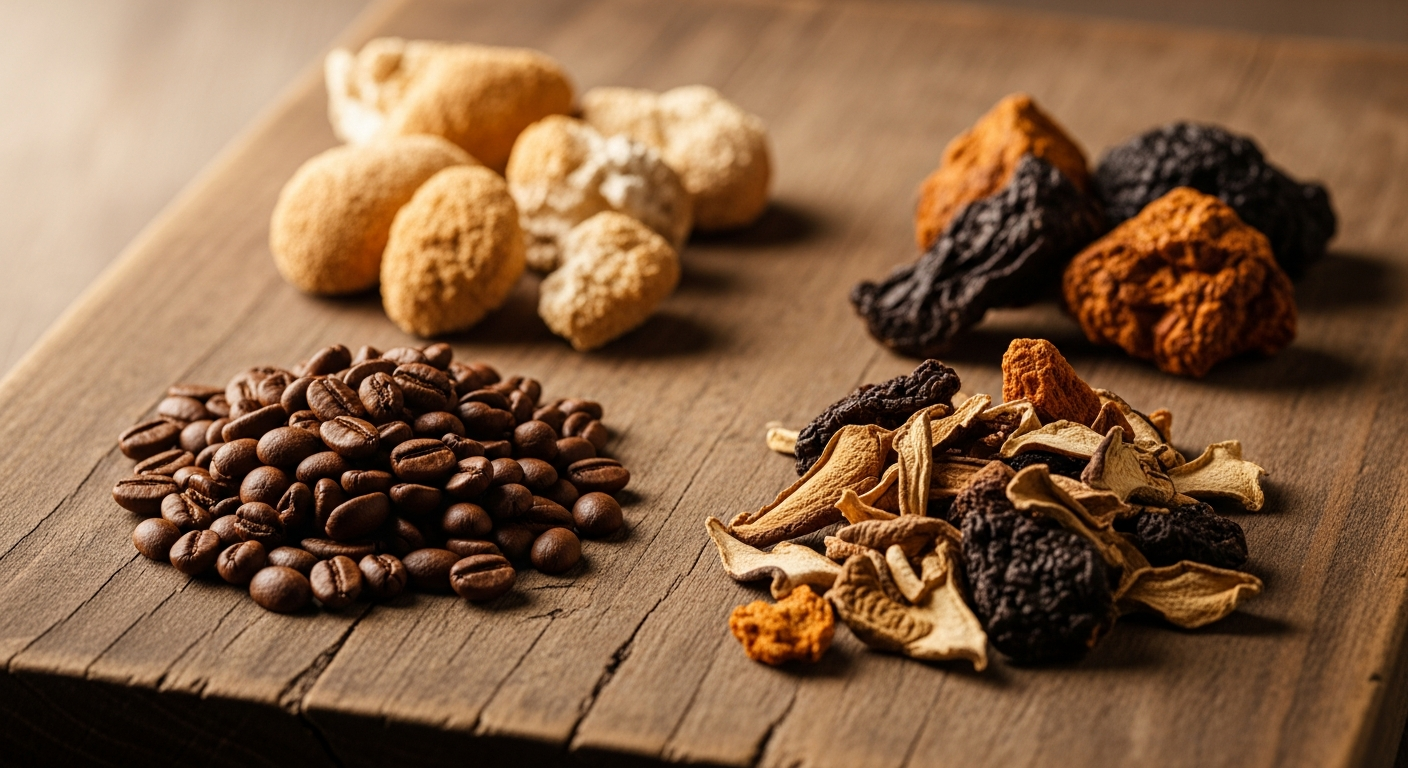
Two Trends, One Shelf
Walk through the coffee aisle at Whole Foods or scroll through Amazon’s “gentle coffee” results, and you will see two categories competing for the same customer: low-acid coffee and mushroom coffee.
Both market themselves as better-for-you alternatives to regular coffee. Both attract buyers who have stomach issues, jitters, or a general sense that standard coffee is too harsh. Both cost more than a bag of Folgers.
But they work through different mechanisms, target different problems, and deliver different results. Grouping them together — as most “best coffee alternatives” listicles do — confuses more than it helps.
What Mushroom Coffee Is
Mushroom coffee is ground coffee blended with powdered extracts of functional mushrooms. The most common species used:
Lion’s Mane (Hericium erinaceus) — Studied for nerve growth factor stimulation and cognitive support. The “brain mushroom.” Research on memory and focus is preliminary but promising.
Chaga (Inonotus obliquus) — High in antioxidants (ORAC scores that exceed most foods). Studied for anti-inflammatory and immune-modulating properties. Grows on birch trees in cold climates.
Reishi (Ganoderma lucidum) — Called “the mushroom of immortality” in traditional Chinese medicine. Studied for immune support, stress response, and sleep quality. The “calming” mushroom in most blends.
Cordyceps (Ophiocordyceps sinensis) — Associated with energy and athletic performance in traditional use. Research is limited but suggests potential effects on oxygen utilization and endurance.
A typical mushroom coffee product contains about 50–70% coffee and 30–50% mushroom extract by weight. Some brands use instant coffee as the base; others use ground coffee. The mushroom extracts are dried, powdered, and blended in.
The taste is close to regular coffee, with a slight earthiness. Most people cannot identify the mushroom component in a blind test, with milk in particular.
Major brands include Four Sigmatic, MUD\WTR (which is more of a coffee replacement than a blend), Everyday Dose, and Ryze.
What Mushroom Coffee Does Not Do
Mushroom extracts do not reduce coffee’s Chlorogenic Acid (CQA) content. The CQA is in the coffee portion of the blend, and adding mushroom powder alongside it does not break down, neutralize, or remove CQA molecules.
Some mushroom coffee brands contain less total CQA per serving than a standard cup of coffee — but only because the serving contains less coffee. If a product is 50% coffee and 50% mushroom powder by weight, you are brewing with half as much coffee. You get half the CQA, half the caffeine, and half the coffee flavor. That is dilution, not acid reduction.
A full-strength cup of mushroom coffee (one that uses enough coffee to taste like coffee) delivers CQA in the same range as any other drum-roasted coffee of the same bean and roast level.
No mushroom species studied to date has been shown to neutralize CQA in the gut or suppress the parietal cell response that CQA triggers. The adaptogenic and nootropic benefits of these mushrooms operate through separate biological pathways.
What Low-Acid Coffee Does
Low-acid coffee — in this case, convection-roasted low-acid coffee — reduces CQA at the source. The roasting process breaks down CQA through thermal degradation before the beans are ground or brewed.
CQA is the primary compound in coffee that triggers excess stomach acid production. Reducing CQA means less stimulation of parietal cells, less hydrochloric acid output, and fewer symptoms for people with acid reflux, GERD, or acid-sensitive stomachs.
This is a targeted intervention. It addresses the specific mechanism that makes coffee hard on stomachs. It does not add adaptogens, nootropics, or immune-support compounds. It is still coffee — the same beverage, with the same caffeine, the same ritual — minus the compound that causes the most GI trouble.
For the full science, see how convection roasting reduces CQA and our CQA explainer.
The Comparison
| Factor | Mushroom Coffee | Low-Acid Coffee (Convection-Roasted) |
|---|---|---|
| CQA reduction | None (same as the coffee base used) | Significant (lab-verified) |
| Stomach acid trigger | Same as regular coffee | Reduced |
| Caffeine content | Lower (less coffee per serving) or same | Same as standard coffee |
| Adaptogens / nootropics | Yes (Lion’s Mane, Reishi, etc.) | No |
| Flavor | Coffee-like with earthy notes | Full coffee flavor, medium roast |
| Brewing flexibility | Varies (many are instant-only) | Any method — drip, pour-over, espresso, cold brew |
| Primary benefit | Cognitive support, stress response, immune function | Stomach comfort, acid reduction |
| Price per serving | $1.50–3.00 | $0.75–1.50 |
The table makes the distinction clear: these products solve different problems.
If your problem is stomach pain, acid reflux, heartburn, or bloating after coffee — CQA is the most likely culprit, and low-acid coffee addresses it. Mushroom coffee does not.
If your problem is jitters, brain fog, afternoon energy crashes, or a desire for functional supplement benefits — mushroom coffee may help through its adaptogenic compounds. Low-acid coffee does not add those compounds.
The Mushroom Coffee Stomach Claim
Several mushroom coffee brands market themselves as “easier on the stomach.” This claim rests on a few arguments:
“Less caffeine.” If the blend contains less coffee per serving, it delivers less caffeine. Caffeine does contribute to GI effects (it stimulates colonic motility and relaxes the lower esophageal sphincter). Less caffeine means a modest reduction in these specific effects. But caffeine is a minor contributor to coffee stomach problems compared to CQA.
“Reishi and Chaga are anti-inflammatory.” Some mushroom extracts have anti-inflammatory properties in cell studies. Whether these effects are strong enough to counteract coffee’s GI irritation in a real human stomach — at the doses present in a single cup of mushroom coffee — is unproven. The research that exists studied mushroom extracts at therapeutic doses, not the amounts found in a blended coffee product.
“Adaptogens reduce stress, and stress worsens gut symptoms.” This is true as a general chain of logic. Chronic stress does worsen IBS and GERD symptoms. Adaptogens may modulate the stress response over time. But this is an indirect, long-term mechanism — not a per-cup effect. Drinking one mushroom coffee on a stressful Tuesday morning will not protect your stomach from the CQA in that same cup.
The stomach-comfort claims are not fabricated. They are extrapolated. Taking real properties of mushroom extracts and applying them to a context (per-cup GI relief) where they have not been tested.
When Mushroom Coffee Makes Sense
Mushroom coffee has legitimate appeal for the right buyer:
You want cognitive support. Lion’s Mane’s potential effects on nerve growth factor and focus are the most compelling research area. If you are interested in nootropics and want them delivered through your morning coffee, mushroom coffee is a convenient vehicle.
You want to reduce caffeine without giving up the ritual. Mushroom coffee blends that replace some coffee with mushroom extract deliver less caffeine per cup. If caffeine — not CQA — is your specific concern (jitters, anxiety, sleep disruption), this reduction helps.
You want immune or adaptogenic benefits. Chaga, Reishi, and Cordyceps have traditional and emerging evidence for various health benefits. Getting a dose through your daily coffee is painless.
You do not have stomach issues. If your stomach is fine and you are drawn to functional mushrooms, mushroom coffee is a reasonable way to incorporate them.
When Low-Acid Coffee Makes Sense
You get heartburn, acid reflux, or GERD from coffee. CQA is the primary trigger. Reducing it is the most direct intervention. See our GERD coffee guide.
You get bloating or stomach pain after coffee. CQA-stimulated acid overproduction causes these symptoms in many people. Reducing CQA reduces the trigger.
You have IBS and coffee makes it worse. CQA is one of multiple IBS-coffee pathways. Removing it helps, though it may not eliminate all symptoms. Our coffee and IBS post covers the full picture.
You want full-strength coffee that tastes like coffee. Low-acid coffee is 100% coffee. No dilution, no mushroom flavor, no compromise on the coffee experience. Same caffeine. Same brewing options. The difference is in the roasting, not the recipe.
You take medications affected by stomach acid. PPIs, H2 blockers, and other acid-management medications interact with gastric acid levels. Reducing a dietary acid trigger (CQA) supports your medication’s job. See our posts on coffee and omeprazole and d-limonene and coffee.
The Combination Option
Low-acid coffee and mushroom extracts are not mutually exclusive. You can combine them.
Start with convection-roasted low-acid beans (like ours). Brew them however you prefer. Then add mushroom extract powder to the brewed cup, or take mushroom extract capsules alongside your coffee.
This gives you CQA reduction (from the beans) plus adaptogenic/nootropic benefits (from the mushrooms) without relying on a pre-blended product where you cannot control the coffee quality or roast method.
Pre-blended mushroom coffees do not disclose their roasting method, and none that we have found use convection roasting. Their coffee base is standard drum-roasted coffee — which means full CQA levels. By separating the two components, you control both.
Mushroom extract powders from brands like Real Mushrooms, FreshCap, and Host Defense can be added to any beverage. A half-teaspoon of Lion’s Mane extract in your morning low-acid coffee gives you both benefits without compromise.
Price and Value
Mushroom coffee is expensive. A 30-serving bag from a major brand runs $30–40, putting the per-cup cost at $1.00–1.33 for what is often an instant coffee product with added powder.
Premium mushroom coffee products (organic, dual-extracted mushrooms, quality coffee base) run $40–60 for 30 servings: $1.33–2.00 per cup.
Low-acid convection-roasted coffee costs more than grocery store coffee but less than mushroom coffee. A 12 oz bag of Low Acid Cafe makes about 20–25 cups, depending on your brew ratio.
If you are buying mushroom coffee for stomach comfort, you are paying a premium for a benefit it does not deliver. The mushroom extracts may provide other benefits worth the price — but stomach acid reduction is not among them.
Reading the Label
If you are evaluating any “stomach-friendly” coffee product, look for:
CQA reduction claims with lab verification. If a brand says “low acid” but offers no data on CQA levels, the claim may refer to pH (which matters less) or may be unsubstantiated. Ask for lab results.
Roasting method disclosure. Drum-roasted, convection-roasted, or something else? The roasting method is the mechanism. If a brand does not mention it, the beans were likely drum-roasted by default.
Additives. Some “low-acid” brands add calcium carbonate or potassium hydroxide to raise pH. This does not reduce CQA. Our post on what low-acid coffee means explains why this distinction matters.
Mushroom extract type. “Mushroom-flavored” is not the same as containing functional mushroom extracts. Look for species names (Hericium erinaceus, Ganoderma lucidum) and extraction method (dual extraction captures both water-soluble and alcohol-soluble compounds).
Coffee-to-mushroom ratio. A product that is 30% coffee and 70% mushroom powder will taste and perform different from one that is 70% coffee and 30% mushroom.
Different Tools for Different Problems
Mushroom coffee and low-acid coffee both represent real innovation in the coffee category. They both deliver something standard coffee does not.
But they deliver different things. Confusing them — or expecting one to do the other’s job — leads to disappointment and wasted money.
If your stomach hurts after coffee, reduce the CQA. That means convection-roasted beans, possibly combined with cold brewing and the other methods in our guide to reducing coffee acidity.
If your brain wants a boost and your stomach is fine, mushroom coffee is worth trying.
If you want both, combine a low-acid coffee base with mushroom extracts. You get targeted acid reduction and functional mushroom benefits in the same cup — each component doing what it was designed to do.
Shop our convection-roasted low-acid coffee or read the science behind CQA reduction.