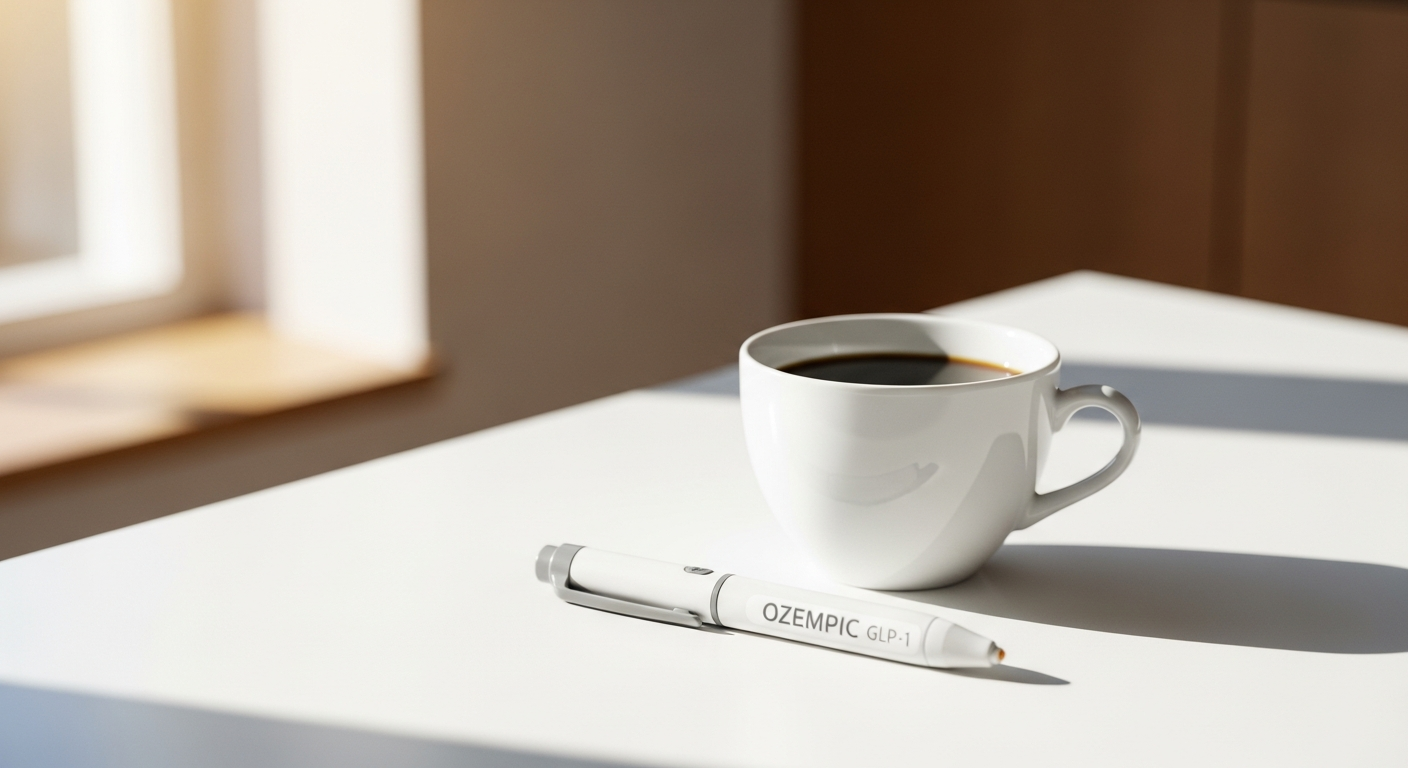
The GLP-1 Coffee Problem
Millions of people are now taking GLP-1 receptor agonists — Ozempic, Wegovy, Mounjaro, Zepbound — for diabetes management and weight loss. These medications are effective at what they do. They are also effective at making your morning coffee feel like a terrible idea.
If you have started a GLP-1 medication and suddenly found that coffee makes you nauseous, gives you acid reflux, or just sits in your stomach like a brick, you are not imagining it. This is one of the most common complaints among GLP-1 users, and it has a clear physiological explanation.
The question is whether you have to give up coffee — or whether there is a better approach.
How GLP-1 Drugs Change Your Digestive System
To understand why coffee becomes problematic on GLP-1 medications, you need to understand what these drugs do to your gut.
Delayed Gastric Emptying
GLP-1 drugs work partly by slowing down how quickly your stomach empties its contents into the small intestine. This is called delayed gastric emptying, or gastroparesis-like effects. It is one of the primary mechanisms behind the appetite suppression these drugs provide — food stays in your stomach longer, so you feel full longer.
The downside: everything you consume sits in your stomach for an extended period. Including coffee. Including the acid your stomach produces in response to coffee.
Increased GI Sensitivity
GLP-1 receptor agonists affect the entire gastrointestinal tract, not just the stomach. Many users experience heightened sensitivity throughout the digestive system, particularly during the dose-titration phase when the body is adjusting. Nausea, bloating, and reflux are among the most reported side effects.
Reduced Lower Esophageal Sphincter Tone
Some research suggests that GLP-1 drugs may affect lower esophageal sphincter (LES) function. The LES is the valve between your esophagus and stomach. When it relaxes inappropriately, stomach acid flows upward — that is reflux. Combine a relaxed LES with a stomach that is holding onto its contents longer, and you have a recipe for significant discomfort.
Why Regular Coffee Makes GLP-1 Side Effects Worse
Coffee hits GLP-1 users hard because of a compound called Chlorogenic Acid, or CQA.
CQA Drives Stomach Acid Production
CQA is the dominant organic acid in coffee. UC Davis researchers identified it as the primary compound responsible for coffee’s ability to stimulate stomach acid production. CQA triggers parietal cells in the stomach lining to produce more hydrochloric acid.
In a normal digestive system, this extra acid is manageable. On a GLP-1 drug, it is not. Your stomach is already emptying slowly. Now you are flooding it with additional acid that has nowhere to go. The acid sits there, the pressure builds, and you get nausea, reflux, or both.
For a detailed explanation of CQA’s role in coffee-related acid issues, see our guide to Chlorogenic Acid.
Caffeine Compounds the Problem
Caffeine relaxes the LES, increases gastric acid secretion on its own, and stimulates gut motility. On a GLP-1 drug where the gut is already in a sensitive, slowed-down state, caffeine’s effects are amplified. What used to be a mild stimulant effect becomes a significant irritant.
The Volume Issue
A standard 12 to 16 oz cup of coffee is a large volume of liquid for a stomach that is emptying slowly. Combine the volume with the acid stimulation and the caffeine effects, and you can see why a single cup of regular coffee can derail your entire morning on Ozempic or Mounjaro.
What GLP-1 Users Are Being Told About Coffee
Most guidance from healthcare providers and GLP-1 online communities falls into one of two camps:
-
“Just quit coffee.” This is the most common advice. It works, but it is also miserable for the roughly 62 percent of American adults who drink coffee daily.
-
“Switch to tea.” Tea has less caffeine and lower CQA, so it is gentler. But if you love coffee, tea is not the same experience. It is not even close.
Neither addresses the problem: specific compounds in coffee interacting with GLP-1-altered digestion. Reduce those compounds, and you may be able to keep your coffee.
How Low-Acid Coffee Can Help GLP-1 Users
The logic is straightforward: if CQA is the primary driver of coffee-induced stomach acid production, and excess stomach acid is what causes nausea and reflux on GLP-1 drugs, then reducing CQA should reduce the problem.
What “Low-Acid” Means (and Does Not Mean)
Not all low-acid coffees are equal. Some brands add calcium carbonate or other alkaline buffers to raise the pH of the brewed coffee. This does not reduce CQA. The compound is still there, still triggering your stomach to produce acid. The pH number on the label looks better, but your stomach does not care about the coffee’s pH — it cares about the CQA hitting your parietal cells.
Coffee that reduces CQA at the source is a different thing. Convection roasting — where beans are roasted with circulating hot air rather than contact with a hot metal drum — breaks down CQA more thoroughly and evenly. The result is coffee with less of the compound that triggers acid production.
At Low Acid Cafe, we use convection roasting on a Sumatran and Chiapas bean blend — origins that are naturally lower in acid — and verify the CQA reduction through lab testing. No additives. No chemical treatment. Less of the compound that makes your stomach react.
Why This Matters for GLP-1 Users
For someone with normal digestion, the difference between regular and low-CQA coffee might mean mild discomfort versus none. For someone on a GLP-1 drug, it can mean keeping coffee in your life versus abandoning it.
Your stomach is already working under constrained conditions on these medications. Removing the biggest acid trigger from your coffee gives your GI system less to deal with.
Practical Tips for Drinking Coffee on GLP-1 Medications
Switching to low-acid coffee is the most impactful change, but these strategies help further:
Timing Matters
- Never drink coffee on an empty stomach while on a GLP-1. This is important for everyone but critical for GLP-1 users. Have at least a small amount of food first — even a few crackers or a banana. Food buffers the acid response.
- Drink your coffee early in the day. GLP-1 side effects, especially nausea, tend to be worse in the morning and around meal times. Give yourself time between coffee and your main meals.
- Time coffee relative to your injection. Many users find that GI sensitivity peaks in the 24 to 48 hours after their weekly injection. If you are in that window and feeling particularly sensitive, scale back.
Start Small
- Cut your portion size. Instead of a 16 oz mug, start with 6 to 8 oz. You can always have a second small cup later if you tolerate the first one well.
- Sip slowly. Flooding a slow-emptying stomach with a large volume of liquid quickly is a fast path to nausea. Take your time.
Consider Cold Brew
- Cold brewing extracts less CQA than hot brewing methods. If you cold brew low-acid beans, you get the lowest possible CQA content — the gentlest coffee combination available. See our brewing guide for tips.
- Cold brew is also naturally smoother and less bitter, which some GLP-1 users find easier to tolerate.
What You Add Matters
- A splash of milk or cream can buffer acidity and slow absorption.
- Avoid sugar and sweetened syrups. Sugar can slow gastric emptying further and contribute to nausea on GLP-1 drugs.
- Skip the butter coffee and MCT oil. High-fat additions can worsen nausea and delayed gastric emptying.
Listen to Your Body During Dose Changes
GLP-1 medications are titrated — you start at a low dose and increase gradually. Each dose increase can temporarily worsen GI sensitivity. Be prepared to adjust your coffee habits during titration weeks. What worked at 0.25 mg may not work the same at 0.5 mg or 1.0 mg.
What About Decaf?
Decaf removes most of the caffeine, which eliminates one of the three main coffee irritants for GLP-1 users. But standard decaf still contains CQA. Many GLP-1 users report that decaf still triggers nausea and reflux, which confirms that caffeine is not the whole story.
If you want to maximize gentleness, a low-CQA decaf would be ideal — removing both caffeine and the primary acid trigger. Standard decaf alone is not enough for most GLP-1 users.
A Note for People Considering GLP-1 Medications
If you are thinking about starting Ozempic, Wegovy, Mounjaro, or a similar GLP-1 drug and coffee is an important part of your life, know that the GI side effects are real but often manageable with the right adjustments. Many users find that symptoms improve after the first few months as the body adjusts.
Having a GLP-1-compatible coffee option lined up before you start can make the transition smoother.
The Bottom Line
GLP-1 receptor agonists change how your digestive system processes everything. Coffee — with its CQA-driven acid stimulation, caffeine effects, and liquid volume — is one of the hardest things for a GLP-1-altered gut to handle.
The solution is not giving up coffee. It is reducing the specific compounds in coffee that cause the problem. Low-CQA coffee, made from naturally low-acid beans and convection-roasted to further reduce Chlorogenic Acid, addresses the cause rather than asking you to abandon something you enjoy.
Combine that with smart timing, smaller portions, and a brewing method that minimizes acid content, and most GLP-1 users can find a coffee routine that works.
Low Acid Cafe was built for this situation — people who need coffee that does not fight their body. Our convection-roasted, lab-verified blend is organic, fair trade, and free of any additives. Learn more about the science behind our approach or browse our shop.
Medical disclaimer: This article is for informational purposes only and is not medical advice. GLP-1 receptor agonists are prescription medications with significant effects on the digestive system. Always follow your prescribing physician’s guidance regarding diet and beverage consumption while on these medications. If you experience severe or persistent GI symptoms, contact your healthcare provider. Do not adjust your medication based on information in this article.